11 Feb 2026
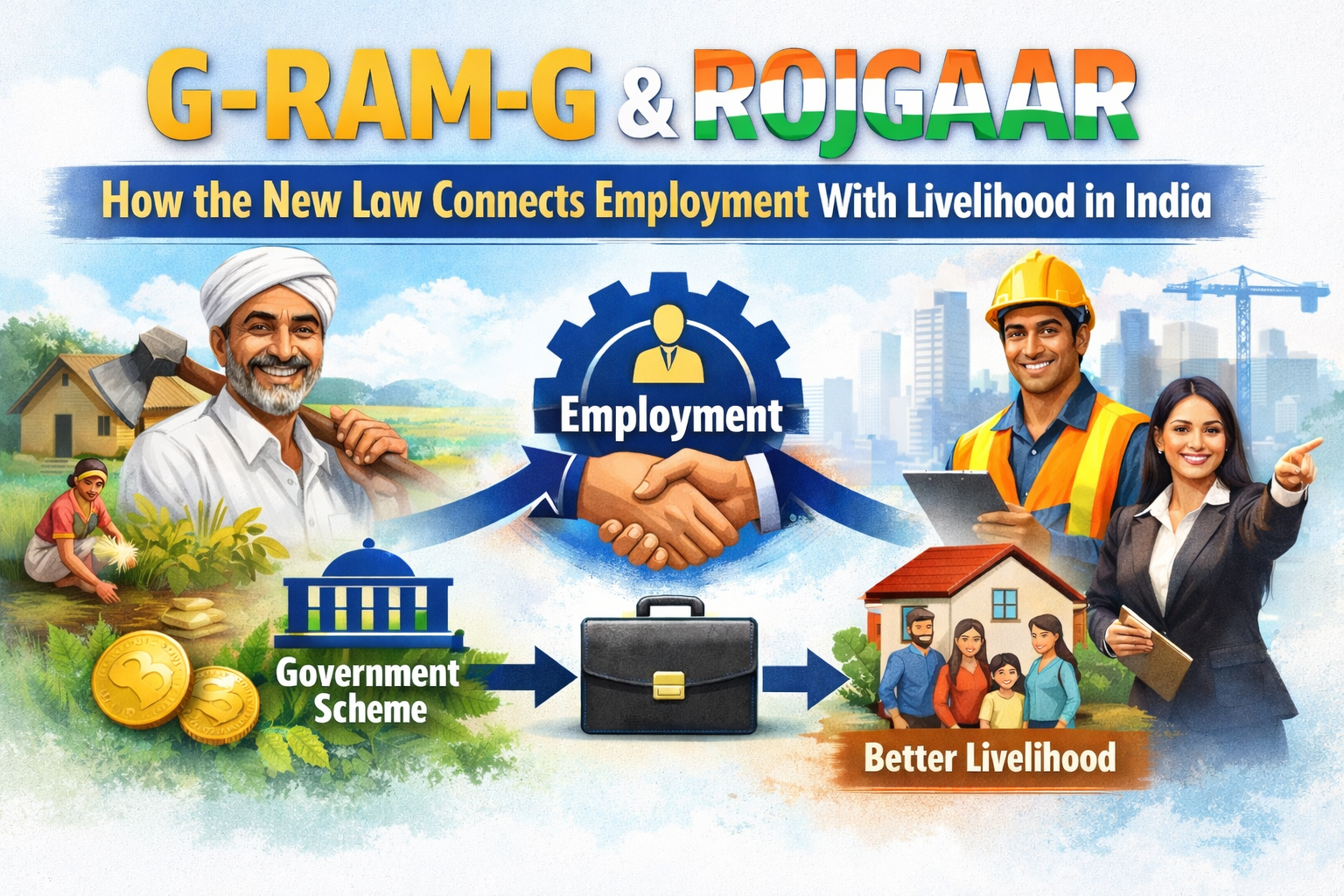
In India, the idea of rojgaar has traditionally meant a stable job — often in cities, offices, or factories. But for millions living in rural and semi-rural areas, especially across states like Uttar Pradesh, Bihar, Madhya Pradesh, Rajasthan, Maharashtra, Tamil Nadu, and Odisha, access to formal employment has always been limited.
The G-RAM-G Act, 2025 directly addresses this gap by redefining rojgaar not as a city-based job, but as locally available, legally guaranteed wage work combined with livelihood creation.
This is why the new law is being discussed as more than a welfare scheme — it is increasingly seen as a structured rural employment model.
At its core, G-RAM-G guarantees paid employment for rural households that voluntarily demand work. Unlike private jobs, this employment:
This ensures that people do not need to leave their villages in search of daily labour or uncertain seasonal work.
For rural India, this is rojgaar with dignity and legal protection.
Many students in rural India face a major challenge:
Under G-RAM-G, rural youth above the minimum working age can legally participate in wage employment during periods when they are not engaged in studies or exams.
In districts of eastern UP, Bihar, MP, and Rajasthan, this can help students stay in education while still contributing economically.
Importantly, this is not positioned as a replacement for education, but as supportive employment during non-academic periods.
One of the most important impacts of rural employment laws in India has historically been women’s participation in the workforce — and G-RAM-G continues this trajectory.
For women in UP, Bihar, MP, Rajasthan, Odisha, and Chhattisgarh, this creates:
In many rural households, this wage income becomes the primary source of financial stability.
For landless labourers, small farmers, and daily wage workers, employment is often seasonal and unpredictable.
G-RAM-G provides:
This stabilizes household income and helps rural families manage:
In regions prone to migration — such as Bundelkhand, eastern UP, north Bihar, and parts of Rajasthan — this can significantly reduce distress migration.
A key shift under G-RAM-G is that employment is linked to:
This means the work done today contributes to:
So rojgaar is not just earning wages, but also building local economic capacity.
G-RAM-G does not replace:
Instead, it acts as a foundation layer of employment security, especially for:
It complements other initiatives by ensuring that no willing rural worker is left without paid work during periods of need.
The most important contribution of the G-RAM-G Act is that it reinforces the idea that employment is a right, not charity.
For students, women, and rural households across India, it offers:
In a country as large and diverse as India, this approach strengthens the social and economic foundation of rural communities — making rojgaar local, lawful, and livelihood-oriented.

No comments yet. Be the first to comment!